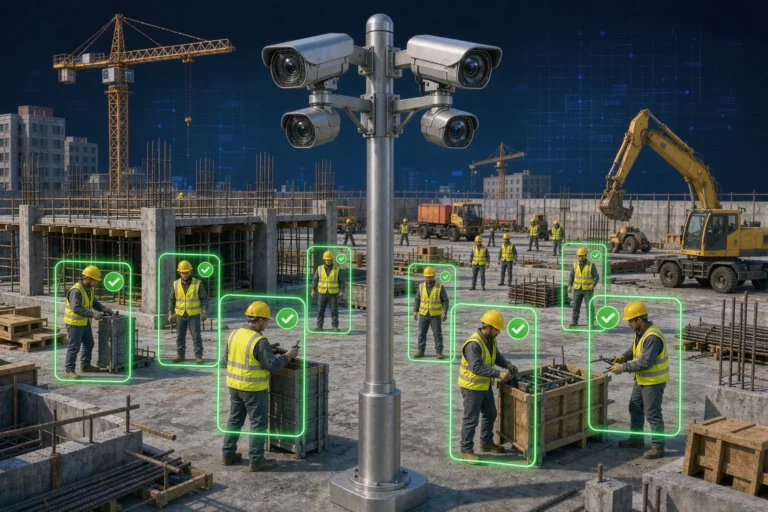
Smoking Detection
Smoking Detection: No-Smoking Enforcement in Restricted Zones
A single match, dropped near a tanker or a solvent drum, is the kind of incident a fire report always traces back to one thing: someone lit up where they should not have. Smoking detection turns every existing camera into an extra pair of eyes on your no-smoking zones, raising an alert in the seconds it takes for a cigarette to be lit — without replacing a single camera on site.
Why Restricted-Zone Smoking Is Still Hard to Stop
Signs, briefings and patrols help, but they all rely on someone being present at the exact moment the rule is broken. Fuel forecourts, chemical stores, paintshops, hospital gas rooms and battery charging areas are the obvious exposure points. Smoke is also one of the most preventable ignition sources in any industrial fire safety programme. A reliable enforcement layer that runs 24/7 is what turns policy into observed behaviour, and that is where video analytics closes the gap.
How Smoking Detection Sees the Gesture
The algorithm looks at the gesture, not the face: a hand rising toward the mouth, the brief presence of a small bright object, and the exhale plume behind it. When the combination matches the model — and the location is inside a configured no-smoking zone — the alert is fired with a short evidence clip. The whole pipeline runs on the edge AI box locally, so detection still works on a plant network that does not reach the public internet.
Where Smoking Detection Earns Its Place
- Fuel stations & forecourts — catch the customer who lights up next to the pump and trigger an automatic PA reminder. Smoking detection at the canopy closes the obvious gap that patrols cannot cover.
- Chemical, paint & solvent stores — keep ignition sources out of the room where a dropped match has the worst consequences.
- Manufacturing cells & battery charging bays — pair with flame detection and smoke detection for a layered defence.
- Hospital gas storage & oxygen rooms — enforce the rule on oxygen-enriched atmospheres where open flame is unforgiving.
- Warehouses & logistics hubs — pair with the broader construction site safety or warehouse safety layer to manage the rest of the ignition risk on the same appliance.
Configurable Rules for No-Smoking Zones
Each polygon on the camera canvas is its own policy. The break room is wide open, the canopy of the forecourt is a hard zero-tolerance zone, and the office stairwell is a softer reminder. You can also decide what counts as smoking: a traditional cigarette, a hand-rolled product, or — where the model is configured and local rules permit — a vape pen. The response is configurable too: a tile in the VMS, a reminder over the IP speaker, an SMS to the supervisor, or a record-only flag for the compliance officer.
Rolling Out Smoking Detection in Days, Not Months
An edge AI box connects to your existing cameras — analogue or IP — and ingests the streams locally. Smoking detection sits in the same library as 198+ other algorithms, so you can enable it alongside flame detection, PPE checks and perimeter rules on the same appliance, scaling from one high-risk camera to 2–128 channels without sending frames off-site. A Starter Kit on a single fuel bay is usually enough to confirm the alert quality and the response workflow before you expand. A practical rollout starts at one canopy camera to validate the gesture against real footage in different weather and lighting, then folds in the chemical stores, battery charging rooms and warehouse entry points one zone at a time, so the VMS dashboard, the IP speaker reminders and the SMS escalation paths are all tuned before the second camera is switched on.
See how it runs on a real site in industrial safety system.
For background on why smoking is restricted in enclosed and hazardous areas, see the WHO tobacco fact sheet.
Common Questions About Smoking Detection
Do I need to swap out my existing cameras? No. The edge AI box sits behind your existing camera fleet and runs the analysis locally, so the camera hardware, the cabling and the NVR stay in place.
Does it work offline or does it need the cloud? It is designed for on-device operation. On a closed plant or station network with no internet, alerts and evidence clips continue to work — an important point at sites with strict data-residency rules.
What does this typically cost a small site? Pricing scales with channel count and the size of the algorithm bundle, not with a recurring per-camera fee. A Starter Kit is available so you can validate the alert quality on one zone before you scale.
How is privacy and compliance handled? Processing happens on your own hardware, so no footage leaves the site. Alerts can be configured as gesture-only clips without identifying faces where the rule allows, and the approach does not replace your fire alarm panel — it augments it.
Enforce No-Smoking Without Replacing Cameras
Stop relying on the next patrol to catch the next match. Tell us your scenario and we will map the high-risk zones on your site and tune the sensitivity to your operation, or start with a Starter Kit to test smoking detection on a single no-smoking area this week. See the related entries flame detection and smoke detection for the wider fire prevention layer.