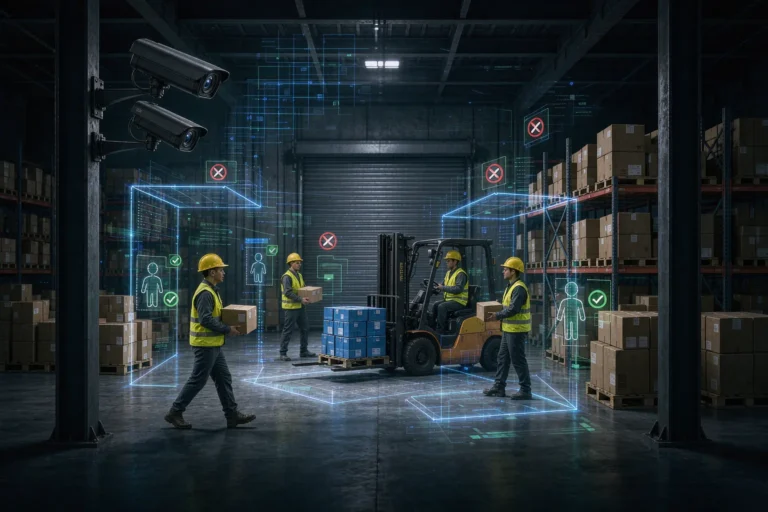
Industrial & Energy Safety System: Hazard, Fire & Compliance AI
Industrial and energy sites do not have a safety problem that analytics can solve. They have a safety system — permits, gas detection, fire panels, PPE rules, shift handovers, contractor inductions — and a set of specific places where that system depends on somebody happening to be looking at the right thing at the right moment. Analytics is useful precisely where that assumption breaks down.
Industrial and energy safety applications sit on top of the safety system you already run. They do not replace gas detection, fire panels or permit-to-work; they cover the gaps between them — the compressor house at 03:00, the contractor who walked into a classified area without an escort, the spill nobody reported because it happened in a corridor with no fixed detector. Those gaps are where the incidents live.
The Compliance Baseline Most Sites Already Carry
Every regulated site carries a documented obligation to identify hazards and control access to hazardous areas, usually met through engineering controls, permit-to-work paperwork and periodic inspection rounds. The paperwork is thorough, the rounds are scheduled, and the incident nearly always happens between rounds.
The useful question is not “are we compliant” but “which of our controls depends on continuous human attention, and how often is that attention actually available”. A control room operator watching twenty-four feeds is not watching any of them. A round every two hours leaves a hundred and nineteen minutes of exposure. Analytics does not remove the obligation — it converts a sample of attention into continuous coverage, and produces a timestamped record that serves an investigation far better than a signed checklist. The hazard-identification framework published by OSHA is the reference most sites are already working against.
Fire and Smoke: The Minutes That Decide the Loss
Fixed fire detection is excellent at what it is designed for and slow at what it is not. A spot heat detector does not respond to a smouldering cable tray in a basement until the plume reaches it. A flame detector needs line of sight. Both work; the gap between ignition and detection is where the loss is decided, and on large sites that gap is measured in minutes.
Video-based smoke and fire detection closes part of that gap because it sees the plume before it reaches a ceiling detector — the camera looks along the space rather than waiting for convection to deliver a sample to a point. It is a complement, never a substitute: the fire panel remains the system of record, and NFPA codes continue to govern where fixed detection goes. Where the concern is a specific high-consequence asset such as a transformer bay or a turbine hall, dedicated fire detection rules on a dedicated camera are usually the first deployment.
Leak, Spill and Housekeeping Signals
Fluid on a floor is one of the most under-detected hazards on an industrial site. It is not covered by gas detection, it does not trigger a fire panel, and it is usually found by whoever walks into it. Video analytics can detect a spreading dark region on a known floor surface, a drip from a valve that was dry last week, or a pool forming under a pump — all as slow-changing anomalies rather than discrete events.
The same logic covers housekeeping and obstruction. Spill response equipment that has been moved, an extinguisher missing from its bracket, an escape route progressively blocked by pallets: each is a change in the expected state of a region, and each is the kind of finding a monthly audit catches long after it mattered. Leak detection and clutter detection are configured the same way — define the expected state, alert on sustained deviation.
PPE, Permits and Access Verification
PPE rules are the most requested and the most frequently mis-specified. The instinct is to cover the whole site with a hard-hat rule and then abandon it when the alert volume becomes unmanageable. The deployments that survive scope PPE tightly: a defined work face, a defined exclusion zone, a defined task window. Inside that scope the rule is accurate and the alerts are trusted.
Our PPE compliance page covers scoping in detail, and the underlying primitives — hard hat, hi-vis vest, workwear — are combined rather than run separately, because a single-class rule generates far more noise than a combined one. Access verification works differently: it does not identify anyone, it checks that a person entering a controlled area is accompanied, equipped and inside a valid permit window, and raises an event when they are not.
What Deployment Actually Looks Like
Deployment starts with footage, not hardware. We take representative recordings from the cameras you already have — including night, shift changeover and bad weather — run them through an appliance, and report what is actually detectable at that camera position. That report, not a datasheet, decides which rules go live.
The appliance then sits inside your network and processes 2 to 128 channels at 1 to 256 TOPS, on-device, with no video leaving the site and no per-camera licence. It runs offline, which matters for remote generation and transmission assets. For plants, the neighbouring concern is usually factory safety; for generation and distribution, energy and manufacturing deployments tend to start with fire, leak and access rules in that order.
How the detection itself works is covered in fire equipment detection.
Frequently Asked Questions
Does this replace our existing gas and fire detection systems?
No, and it should not. Fixed gas detection and fire panels remain the systems of record and the ones your procedures are built around. Video covers the spaces and failure modes they do not — outdoor areas, large-volume interiors, smouldering sources and slow leaks — and reports into the same control room.
Can it be used in hazardous or classified areas?
The processing appliance sits in a safe area and connects to cameras over your existing network. Where cameras are already installed in a classified area they are already certified for it, and adding analytics does not change that certification because the camera hardware is untouched. New camera placements in classified areas follow your existing approvals process.
How do you control false alarms on flame and smoke detection?
By scoping and by validation. Each rule is bound to a specific region, hot work and welding are excluded by permit windows, and detections are confirmed across consecutive frames before an event is raised. Thresholds are then tuned against your own footage rather than a generic model, which is the single largest lever on false alarm rate.
What if the site has no reliable connectivity or older cameras?
Neither is a blocker. Inference runs on the appliance and events are stored locally, so a site with no backhaul still gets full analytics and synchronises when a link appears — a scheduled sync, a site visit, or never. The platform is built to make the cameras you already have useful, so you keep your cameras, your VMS and your network and add an appliance; the capital cost of a plant-wide camera upgrade is exactly what makes these projects stall.
Tell Us Your Scenario
Every site draws its regions differently, and the gap between a rule that works and a rule that gets switched off is usually thirty minutes of configuration against real footage. Send us your camera layout and the behaviour you need to catch, and we will tell you which of the 198+ algorithms fit and what accuracy to expect on your own video. Tell Us Your Scenario — or start with a Starter Kit preloaded with tested configurations, running on your own cameras in a single afternoon.