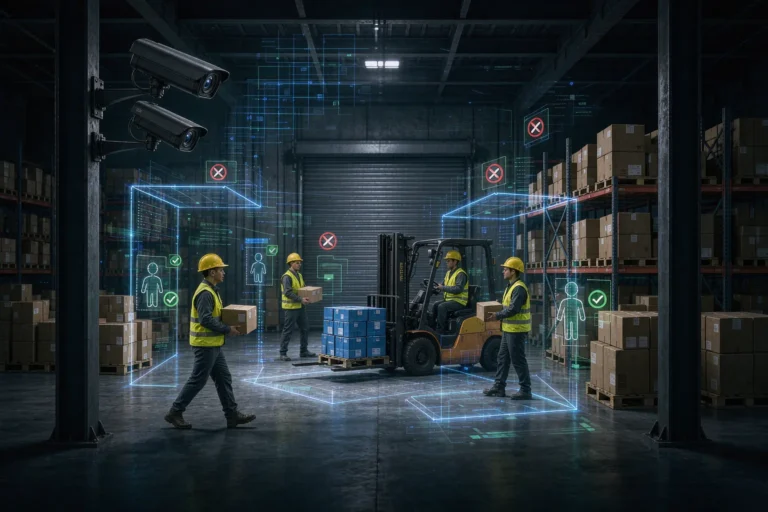
Gas Station Safety & Security System | AI Fuel Site Monitoring
A gas station packs fire risk, fuel handling and public foot traffic into a tight, always-open space. Enforcing no-smoking, no-phone and no-motorcycle rules by eye is unreliable, and a single lapse at the pump can turn serious fast. A gas station safety system built on edge AI lets your existing cameras enforce those red lines automatically — day and night, across every shift. This guide covers the real risks, the detections that handle them, and how to deploy without touching your CCTV.
Why Fuel-Station Rules Are Hard to Enforce
Attendants cannot watch every customer and every pump at once. Smoking near fuel, phone use at the dispenser, and motorcycles entering the forecourt are exactly the behaviors that cause incidents — yet they happen in seconds and are easy to miss. Traditional CCTV only records after the fact. A gas station safety layer analyzes live video and alerts the moment a red line is crossed, so staff can act before anything escalates.
Five Management Challenges at a Fuel Station
- Red-line behavior: smoking, phone use and motorcycles in restricted zones are constant, hard-to-police risks.
- Fuel unloading: tanker deliveries are high-consequence moments where procedure violations or leaks must be caught immediately.
- Hazardous vehicles: tankers and chemical carriers need controlled access and logging.
- Forecourt security: loitering, trespass and confrontations at the pump put staff and customers at risk.
- Camera uptime: a blocked or shifted lens at the pump or cashier leaves a blind spot exactly where you need coverage.
The Solution: Red-Line Behavior, Unloading & Hazard Control
The strength of a gas station safety system is combining several detections on the same cameras. One edge box runs them together and routes every alert to one panel.
Enforcing the three red lines
Smoking detection and phone-use detection flag the two most dangerous forecourt behaviors the instant they appear, while motorcycle-intrusion detection stops two-wheelers from entering prohibited areas. See OSHA for general fuel-dispensing safety context.
Fuel-unloading compliance
During tanker delivery, fuel-unloading detection confirms each step of the procedure is followed, and leak-and-spill detection catches seepage early. Combined with flame detection and smoke detection, the unloading window gets full coverage from first sign to resolution.
Hazardous-vehicle control
Hazardous-material restriction detection keeps banned carriers out, while license plate recognition logs every vehicle in and out for audit and follow-up.
Forecourt security and camera health
Intrusion, loitering and fighting detection cover the pump and cashier areas; camera-tampering detection alerts you the moment a lens is blocked or moved, so coverage never silently fails.
How These Detections Work Together
A key advantage is the shared alert workflow. One edge box can run several algorithms on the same cameras and route all alerts to a single panel or platform. When a smoking event fires, it locks the relevant feed and notifies staff; when a tanker arrives, it opens the unloading checklist. The result is a coordinated gas station safety system, not a patchwork of alarms. Because the platform runs 198+ algorithms across 2–128 channels and up to 1–256 TOPS on-device, you add new detections later without touching the cameras or wiring.
Deploying at the Pump, Cashier and Entrance
Start by auditing your cameras and defining risk zones: dispensers, the cashier counter, the entrance and the unloading bay. Connect an edge AI box to your network, draw virtual zones and set thresholds, then route alerts to your team. Because it all runs on-device, you keep data local, avoid cloud fees, and keep watching even if the internet drops. Most stations can be up and running within a week. A Starter Kit lets you validate detections on a few cameras first — confirm smoking and phone-use alerts at the pump, tune the unloading checklist for your bay — before rolling out across all channels. For fire-safety principles behind the setup, see NFPA.
Who Benefits Most
This fits chain operators, independent stations and fleet-park fuel sites alike. Chain and independent owners gain consistent enforcement without extra guards; logistics-park stations get a single view of fuel handling across the yard. Link several sites to a central dashboard for unified oversight and reporting.
Common Questions About Gas Station AI Safety
Can it spot a customer on the phone and warn them on-site? Yes — pair the detection with a speaker or on-screen alert to remind them at the pump in real time.
Does it record fuel-unloading compliance? Yes — each delivery event is logged with time and camera, giving you an audit trail for procedure and insurance.
Can a national chain manage every site from one backend? Yes — link multiple stations to a central dashboard for unified oversight and reporting.
Build Your Gas Station Safety System
Protect your forecourt, your staff and your customers. Tell us your scenario and we’ll recommend the right detection set, or start with a Starter Kit to test on your own cameras before scaling.