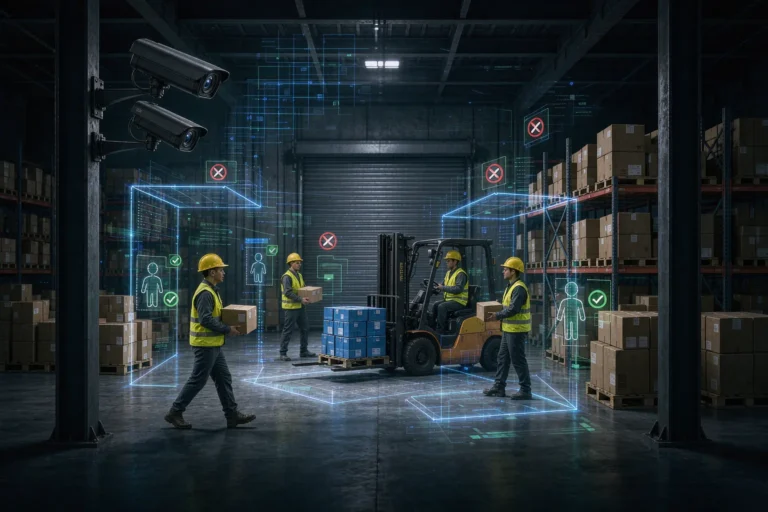
Construction Site Safety Monitoring with AI: See Hazards Before They Happen
Construction site safety monitoring is one of the fastest ways to reduce accidents on active jobsites — and it works with cameras you already own. In the United States alone, falls, struck-by incidents, electrocutions and caught-in/between hazards take hundreds of construction workers’ lives every year. Many of those incidents share a common pattern: a hazard existed for minutes before anyone noticed. AI video analytics closes that gap by watching every feed, all day, without fatigue.
Why Construction Site Safety Monitoring Matters
The U.S. Bureau of Labor Statistics consistently lists construction among the most dangerous industries, and OSHA’s “Fatal Four” — falls, struck-by, caught-in/between, and electrocution — account for the majority of construction fatalities. OSHA publishes extensive construction industry safety guidance, but even the best-written safety program depends on enforcement at the moment a hazard appears. Traditional safety walks are valuable, yet a supervisor can only be in one place at a time. A single 50-camera site produces more video than a team of people could ever review.
Construction site safety monitoring with edge AI changes the economics of safety. Instead of hiring people to watch screens, the system watches for you. It detects the moment a worker enters an exclusion zone, the moment a hard hat comes off, or the first sign of smoke near a welding station. Alerts go to the foreman’s phone in seconds, while the incident is still unfolding. That is the difference between a near miss and a reportable injury.
Measuring safety in dollars makes the business case obvious. The direct and indirect cost of a single lost-workday injury on a construction site routinely runs into six figures, and a fatal fall can cost millions. Measured against that exposure, construction site safety monitoring that runs on cameras you already own is remarkably cheap insurance — most systems justify their cost long before any serious incident occurs.
How AI Monitors Construction Sites in Real Time
A modern edge AI system runs several detection models on every camera feed simultaneously. Here is what a typical deployment watches for on a mid-size building site:
Hard-Hat & PPE Detection
Missing personal protective equipment is one of the most common and most visible violations on site. AI models trained for hard hat detection recognize whether every person in frame is wearing a helmet, a hi-vis vest, or both. The system flags the violation immediately instead of relying on a supervisor to spot it later. For a full breakdown of how this works on-device, see our guide to hard hat detection powered by on-device AI.
Smoke & Fire Detection
Welding sparks, temporary electrical wiring and stored materials create fire risks that are easy to miss until it is too late. Vision-based smoke and fire detection spots flames and smoke plumes in the earliest seconds, even outdoors where traditional smoke detectors cannot be used. An early alert buys the minutes that let crews react while the fire is still small.
Zone & Perimeter Intrusion Detection
Excavations, crane swing zones, roof edges and storage areas can all be configured as restricted zones. When someone crosses the boundary, the system triggers an alert with a snapshot and a clip. Perimeter intrusion detection also helps secure the site after hours, flagging trespassers who should not be anywhere near heavy equipment.
On-Device vs Cloud: The Edge Advantage
Many construction sites sit at the edge of a stable internet connection, or have none at all. That is precisely why on-device processing matters. Our platform runs 198+ industry algorithms directly on a compact edge AI box with 1–256 TOPS compute, supporting 2–128 channels per system — the sweet spot for cost efficiency on most projects. Video is analyzed where it is captured, so alerts arrive in under a second and footage never has to leave the site. That keeps sensitive site data private and keeps the system running through network outages.
For companies running multiple projects, one dashboard aggregates alerts from every site while the analysis stays on each site’s edge box. Site managers get real-time notifications, safety officers get weekly trend reports, and head office gets visibility without visiting every job. Construction site safety monitoring becomes a company-wide program rather than a per-site experiment. If a site has no cameras yet, our breakdown of how to specify site cameras is the place to start.
Does It Work on My Existing Cameras?
In most cases, yes. If your site already has IP cameras with an RTSP stream, they can feed into the edge AI system without being replaced. That means lower upfront cost, faster deployment, and no disruption to the equipment your team already knows. Construction site safety monitoring only becomes useful when it is actually installed and running, and reusing existing cameras removes the biggest barrier to that first deployment. If you want to test the concept before committing, the Starter Kit is designed exactly for that — a hands-on way to see detection working on your own site within days.
Get a Free Solution for Your Site
Every jobsite is different, and the right detection mix depends on your layout, your trades and your local regulations. Tell us your scenario and we will map a free solution design for your site — including which cameras to connect, which algorithms to enable, and what to expect in the first week. You can also review real-world deployments and industry guides across our construction safety resources.
For the algorithm in detail, see safety signage recognition. For the algorithm in detail, see safety harness detection.
More on this in about us. See how it runs on a real site in AI Solutions for Construction: Full-Site Safety Guide.
Construction has its own regulatory track in most markets — see the HSE construction sector guidance for how site safety duties are framed in the UK.
Frequently Asked Questions
Which site risks can it detect?
Sites usually start with PPE detection for helmets and hi-vis vests, after-hours intrusion and perimeter breach, then add zone rules such as exclusion around plant or excavation edges. The 198+ algorithm library covers the rest, and the rules follow your method statement.
Does it work on a site with no internet?
Detection runs on the edge box at the site, so it keeps working without a connection. The internet is only needed to deliver alerts to a phone or dashboard off site, and for remote tuning by our engineers.
Can it keep up as the site changes every week?
Yes. Zones and rules are software, so when a workface moves you redraw the area in minutes rather than moving hardware. Most sites re-scope zones at each phase handover.
Who owns the footage?
You do. Video and events stay on the box installed at your site, and nothing is uploaded to a third-party cloud for processing, which also keeps retention under your own control.
How fast can we get a working demo?
For configuration-only deployments the first working demo is typically delivered in about seven days. If a rule needs new algorithm development for an unusual hazard, the first demo date is quoted together with the scope.