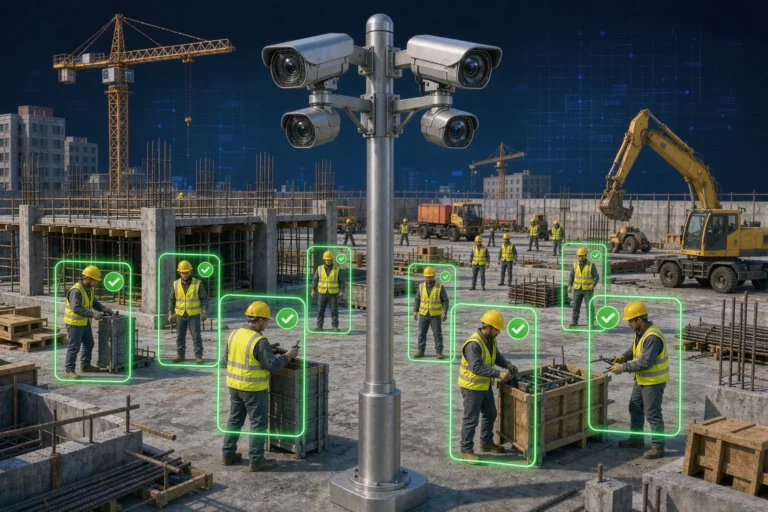
Perimeter Intrusion Detection: AI Wall & Fence Security
Every perimeter system ever installed has eventually been defeated by something small and furry, or by a hedge in wind. That is the honest starting point for any discussion about perimeter intrusion detection: the technology works, but only when the zone, the schedule and the object filter are configured for the specific fence line in front of the camera. Done properly, it replaces the worst job in security — a human watching a dark boundary on a monitor for eight hours — with a rule that never blinks.
What Counts as an Intrusion
The definition is yours to set. The system is given one or more regions per camera, a schedule, and the object classes that matter inside those regions. A person entering the compound-side of the north fence between 19:00 and 06:00 is an intrusion. A person walking past on the public pavement outside the same fence is not. A vehicle stopping at the gate is not; a vehicle circling the rear boundary twice in five minutes is.
That last example is why intrusion logic belongs in a video platform rather than in a beam or a fence sensor. A beam tells you something crossed a line. Video tells you what crossed it, in which direction, how many times, and gives you the clip.
How the Detection Works
Each stream is processed frame by frame on the appliance. The model locates and classifies objects — person, vehicle, two-wheeler — and assigns a track ID that persists while the object is visible. When a tracked object of a monitored class enters a defined region, the rule evaluates three conditions before firing: is the object class in scope, is the current time inside the armed schedule, and has the object remained inside the region for the minimum dwell you configured. Only then does the event fire, with a snapshot, a short clip and the zone name.
The underlying discipline is video analytics rather than simple motion detection — the Security Industry Association publishes guidance on its use in physical security, and the technical foundation is summarised under video analytics.
Beating the False-Alarm Problem
Four adjustments handle the overwhelming majority of nuisance alerts:
- Class filtering — arm the rule for people and vehicles only. Cats, foxes and birds stop existing as far as the rule is concerned.
- Minimum dwell — require the object to remain in the zone for two or three seconds. This alone removes passing traffic, headlight sweeps and most shadow artefacts.
- Ignore zones — paint out the areas that generate noise: a swaying tree, a reflective fence panel, a road visible through the boundary.
- Schedule — disarm during shift change, deliveries and any predictable period of legitimate traffic near the line.
Sites that complain about false alarms almost always have the dwell set to zero and no ignore zones. Spending an hour on the first week’s footage saves months of frustration.
What Happens When It Fires
Detection without response is just logging. The event can drive a local relay for a floodlight or siren, push a notification to a guard’s device with the snapshot attached, drop the clip into the VMS bookmark list, and escalate to a second recipient if nobody acknowledges within a set time. Most sites run a tiered response: light and siren first, guard notification second, because a large share of intruders leave the moment the area lights up.
Where Perimeter Rules Are Deployed
Construction compounds use them for tool and copper theft, typically layered with construction site safety rules on the same cameras. Utilities and substations use them for unauthorised access to high-consequence assets. Warehousing and logistics yards protect the fence line and the trailer park. Residential and mixed-use developments run them on the boundary after hours, alongside abandoned object detection near entrances where a left package matters more than a person.
Two supporting rules are worth enabling from day one. Camera tampering detection reports a lens that has been sprayed or covered, and camera displacement detection catches a bracket that has sagged or been knocked — both are the standard first move of anyone planning to come back. Where the boundary is also a vehicle route, pairing with vehicle detection lets you hold the rule for people at night and for vehicles at weekends.
For the wider site design around this, start from gated community security cameras.
It is one of the detections most often paired with apartment complex security cameras.
This is applied end to end in perimeter security system. The longer explanation sits in virtual fence system.
It is one of the detections most often paired with data center security cameras.
For the wider site design around this, start from solar farm security cameras.
See it applied end to end in our guide to how AI cameras compare with conventional CCTV.
See it applied end to end in our guide to two-wheeler entry alerts.
For the wider context around this, see smoke detection in racking.
Common Questions
Do I need to replace my cameras or add fence sensors? Neither. Intrusion zones are drawn on your existing CCTV feeds through an on-premise appliance; no beams, no taut wire, no camera replacement.
Does it work in the dark? Yes, with adequate IR or ambient lighting on the fence line. Detection is significantly better when the boundary itself is lit — a lighting upgrade is often the cheapest accuracy improvement available.
Will animals trigger it? Not when the rule is armed for people and vehicles only. Class filtering plus a short minimum dwell removes virtually all animal and weather events.
What does a perimeter deployment cost? Far less than sensor-based alternatives on the same boundary. Cost scales with channels and algorithms, and you can pilot on the two or three cameras covering your worst fence line.
Does it keep working without internet? Yes. All inference runs on-device, so detection, relays and local alarms continue through an outage; only remote push notifications pause.
Draw Your First Zone
Pick the boundary you worry about most and we will help you configure the schedule and filter set for it. Tell us your scenario — fence length, camera count and hours of concern — or start with a Starter Kit and run it against a week of your own footage. Related: how to secure a construction site and running detection for chase and escape behaviour.