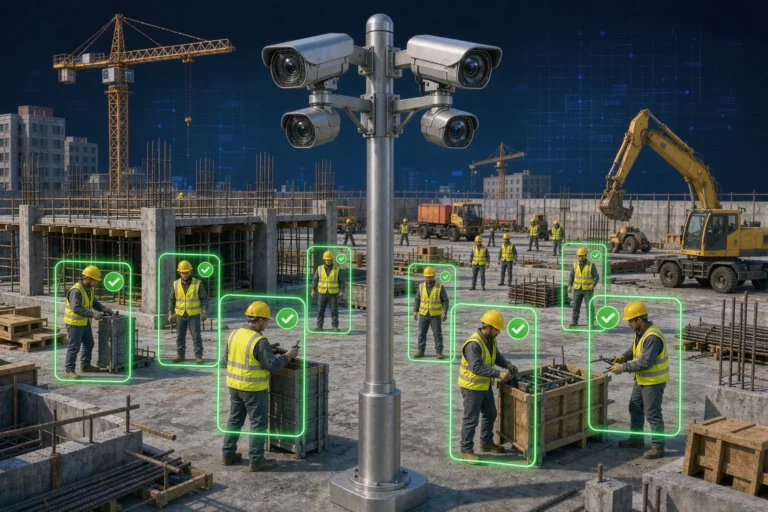
Vehicle Detection: Traffic & Property Monitoring
Knowing that a vehicle is present is easy. Knowing that it is a rigid truck rather than a van, that it has been sitting in the loading bay for forty minutes, and that it entered from the wrong direction — that is what turns a camera into an operations tool. Vehicle detection is the perceptual foundation for almost every traffic and property-monitoring use case: before a system can count, classify, track or match anything, it has to reliably decide that there is a vehicle in the frame and where its bounding box is.
It is a classic computer-vision problem, which is why the technique is well documented: the Object detection literature covers how models localise and classify objects in a frame, and the Security Industry Association (SIA) publishes guidance on applying it in operational surveillance.
What Vehicle Detection Is Actually Used For
Detection on its own rarely closes a business case; it becomes valuable as the first stage of a chain. The typical downstream consumers are:
- Counting and occupancy — how many vehicles are in a zone right now, and how that number trends through the day. Where the requirement is a floor rather than a figure, minimum vehicle presence detection alerts when the count drops below it.
- Classification — separating cars, vans, trucks, buses and two-wheelers, so a rule can apply to one class only.
- Tracking through a zone — following one vehicle across cameras to derive direction, route and dwell time.
- Triggering a second detector — a detected vehicle inside a marked area is what arms plate capture, speed estimation or an overheight check.
Most sites buy it for the first reason and then discover the fourth is where the money was.
How the Model Sees a Vehicle
Modern detectors regress a bounding box and a class probability in a single pass, which is what allows them to run in real time on modest hardware. In practice three things determine whether the output is usable on a given camera:
- Viewing angle. A camera mounted low and close produces heavy occlusion in a car park; one mounted high and looking down separates vehicles cleanly. Detection quality is mostly a lens-position problem, not a model problem.
- Object size in pixels. Every detector has a minimum useful object size. A vehicle occupying fewer pixels than that threshold at the far end of the view will be missed regardless of model choice.
- Stability of the region of interest. Drawing the zone tightly is the single highest-leverage tuning step available — it removes the moving background (swaying trees, passing pedestrians, headlight glare on wet tarmac) that generates most false positives.
Our edge boxes cover 2–128 channels with 1–256 TOPS, so the same deployment can run lightweight detection on distant overview cameras and heavier classification on gate cameras. And because the full library of 198+ algorithms ships on the device, the detection output can be handed straight to speeding detection or wrong-way detection without adding hardware.
Pairing Detection With Plate Recognition and Perimeter Logic
Detection is the trigger; identity is the payload. A common pattern is to use vehicle detection as a cheap, always-on gate, and only invoke license plate recognition when a vehicle crosses a virtual line. That ordering keeps compute low and gives you clean, single-frame plate captures rather than thousands of redundant reads per hour. The reverse pattern also works: a plate event with no corresponding vehicle detection is a useful signal of a recognition error worth reviewing.
The same idea applies to property protection. A vehicle detected inside a perimeter zone outside opening hours is a very different event from a person detected in the same zone, and splitting them lets security teams triage correctly. Sites that also care about fire risk often run smoke and flame detection on the same perimeter cameras.
Who Deploys It
Parking and terminal operators use it for occupancy and dwell analytics. Logistics sites use it for yard and gate throughput. Property managers use it to distinguish a delivery at 3pm from an unfamiliar vehicle at 3am. Transport authorities use it as the input layer for traffic measurement. The variations are many, but the underlying question is always the same: what decision will this detection drive?
It is one of the detections most often paired with hotel security cameras.
The wider site design around it is covered in ai solutions for transportation.
It is one of the topics we cover separately in vehicle count limit detection.
This is one of the topics we cover in more detail in fuel unloading compliance.
FAQ
Does it work at night? Yes, with the usual caveats. Detection holds up well in low light as long as there is some illumination, and infrared cameras work fine because the model reads shape rather than colour. The common night-time failure is not darkness but headlight bloom and wet-surface reflection, both of which are handled by tightening the region of interest and applying a minimum-dwell threshold.
Can it tell a truck from a car? Yes. Classification into cars, vans, trucks, buses and two-wheelers is standard, and class-specific rules are where most of the operational value sits — for example alerting only when a truck, and not a car, stops in a fire lane.
Will we have to upgrade our cameras? Usually not. Detection consumes standard RTSP streams, so existing cameras, cabling and recording infrastructure stay as they are. The analytics run on an edge box alongside them, and it keeps working with no internet connection because inference is local — which also means vehicle footage never has to leave your premises.
What does it cost to run? The hardware is a one-time purchase sized by channel count and compute, and there is no per-camera cloud subscription, so a site that doubles its camera count does not double its monthly bill. The sensible first step is a Starter Kit on your own footage to confirm accuracy before committing to a larger rollout.
Tell Us Your Scenario. Counting, classifying or triggering — tell us which one matters and we will configure the detectors to match. Test it on your own camera feeds with a Starter Kit, or send us your layout and we will recommend a channel count.