
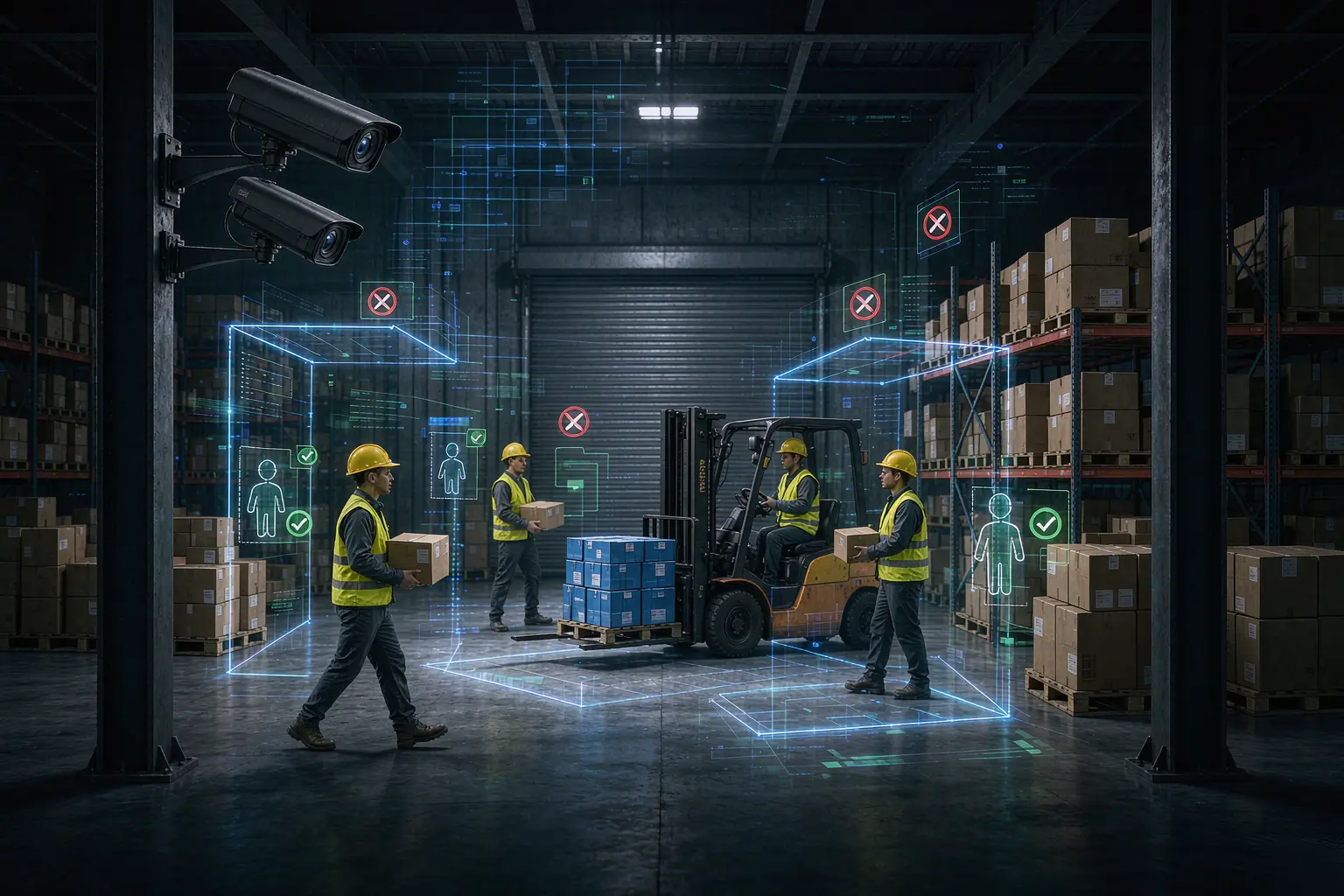
Warehouse Safety System: The AI Detections That Work Together
A warehouse is a high-risk building: large open space, fast-moving forklifts, stacked goods, and often weak early-fire detection. You can’t fix every hazard with one camera — you build a warehouse safety system by combining several AI detections that work together on the same set of cameras. This guide shows which detections to combine, how they cooperate, and how to deploy them without replacing your CCTV.
Why a Warehouse Needs More Than Recording
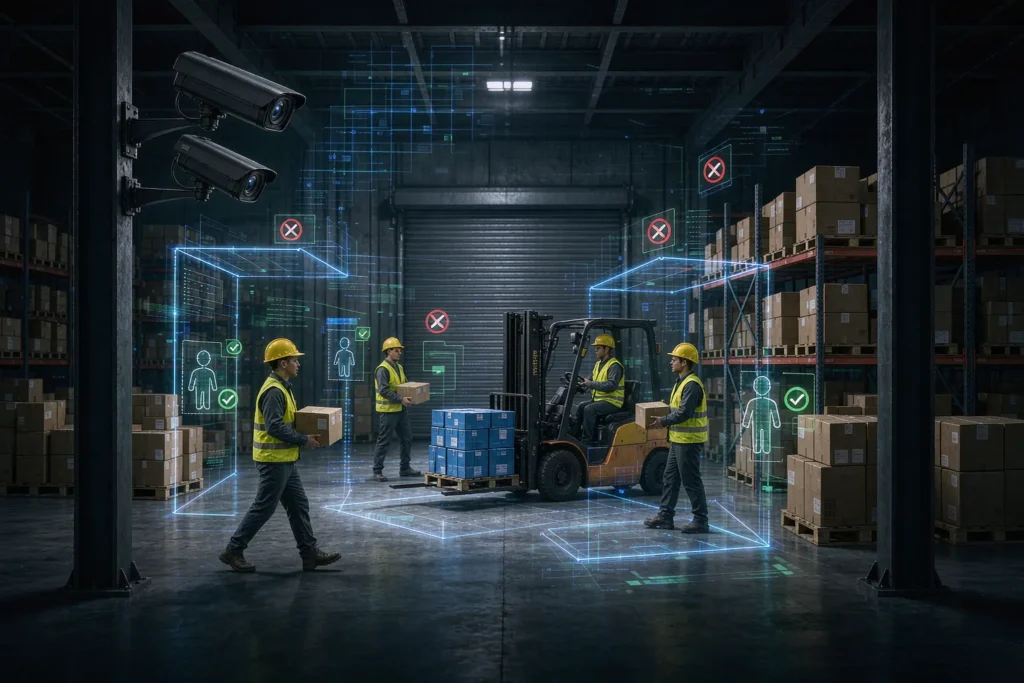
Traditional CCTV records incidents after they happen. A warehouse safety system prevents them by analyzing live video and alerting in real time. Because warehouses pack many risks into one space, no single algorithm is enough — the value comes from combining fire, people and fleet detection into one dashboard.
The Detections That Work Together
Fire and smoke detection
Large open areas make early fire detection hard for point sensors. AI flame and smoke detection watches camera views and flags a potential fire in seconds, giving your team time before it spreads. Pair it with equipment-in-place checks so extinguishers and hydrants are always accessible. See the NFPA for warehouse fire safety guidance.
Clutter and housekeeping detection
Blocked aisles and piled material are both a safety and a fire-path problem. Clutter detection senses obstructions in walking and emergency routes, keeping escape paths clear.
People and staffing monitoring
Warehouse safety system coverage includes people counting, overcapacity alerts and workstation-abandonment detection, so you know when areas are overcrowded or understaffed.
Forklift and vehicle fleet safety
Forklifts cause many warehouse injuries and are hard to govern by eye. Vehicle-speeding and wrong-way detection limit indoor speed and direction, while license plate recognition controls vehicles entering and leaving. OSHA publishes specific guidance for this environment — see OSHA warehousing resources.
Camera health
Camera-tampering detection alerts you the moment a lens is blocked or moved, so coverage never silently fails.
How These Detections Work Together
A key advantage of combining them is the shared alert workflow. One edge box can run several algorithms on the same cameras and route all alerts to a single panel or platform. When fire detection fires, it locks the relevant camera feeds; when a forklift speeds, it logs the plate for follow-up. The result is a coordinated warehouse safety system, not a patchwork of alarms.
Deploying a Warehouse Safety System
Start by auditing your cameras and defining risk zones: racking, aisles, docks, yards. Next, pick the algorithms that match those risks. Connect an edge AI box to your network, draw virtual zones and set thresholds, then route alerts to your team. Because it all runs on-device, you keep data local, avoid cloud fees, and keep watching even if the internet drops.
Most warehouses can be up and running within a week. A Starter Kit lets you validate detections on a few cameras first — confirm the fire sensor sees your loading bay, tune clutter detection for your aisle width, and check vehicle-speed thresholds against real forklift traffic — before rolling out across 2–128 channels. Because the platform runs 198+ algorithms on one box, you can add new detections later without touching the cameras or wiring.
What to Expect from Detection Accuracy
AI detection is reliable, but it is not magic. Detection quality follows your camera quality and lighting closely — a well-lit, unobstructed view gives the cleanest results, while heavy occlusion, backlighting or extreme low light can reduce accuracy and occasionally cause a missed or false alert. Blind spots are usually a coverage problem, not an algorithm problem: a camera that has sagged or been blocked simply stops seeing, so a quick lens and angle check matters as much as the model. That is why we recommend validating detections against your own footage before scaling: tune thresholds on a week of real warehouse video, confirm the fire sensor sees the loading bay clearly, and add targeted lighting where a view is weak. Because alerts run on your edge box in seconds, you can watch live and adjust without waiting on the cloud. No system removes every false alarm, but tuning against your actual environment is what turns a generic model into a warehouse safety system that fits your site.
We walk through the reasoning in warehouse security camera cost. The longer explanation sits in cctv for warehouse.
See how it runs on a real site in AI Solutions for Education: Campus Safety & Management.
Common Questions About Warehouse AI Safety
Do I need to replace my existing cameras? No — the system works with the cameras you already have.
How fast is the alert after an event? Edge processing alerts within seconds, on-site.
What if I only need fire detection today? Start there and add algorithms later — the platform supports 198+ and grows with your needs.
Can I manage multiple warehouses? Yes, link several sites to a central dashboard for unified oversight.
Will the system slow down my network? No — video analytics run on the edge box, not on your cameras or NVR, so the existing network load barely changes.
Build Your Warehouse Safety System
Protect your goods, your people and your operations. Tell us your scenario and we’ll recommend the right detection set, or start with a Starter Kit to test before scaling. Not sure where to begin? Read our guide to upgrade cctv to ai for the practical first step.