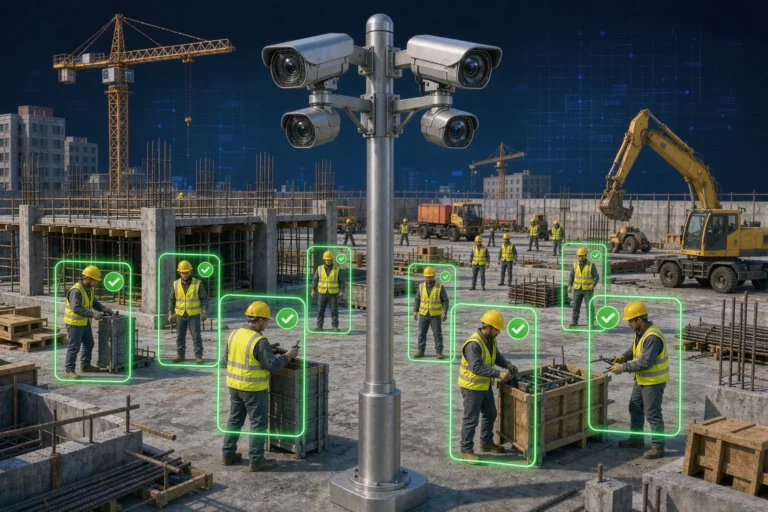
Face Recognition & Verification: ID & Access Control
Access control has a persistent weakness: the credential is checked, not the person. A card gets borrowed, a PIN gets shared, a tailgater walks in behind a legitimate employee, and the log records an entry by someone who was never in the building. Cameras at the door record all of it, and nobody reviews any of it.
Face recognition closes that gap by checking the face against the credential. Used properly it is not a surveillance dragnet — it is a verification step at a controlled point: a turnstile, a muster station, a server room door, a contractor gate. The camera sees a face, the system compares it against an enrolled list, and the door behaves accordingly. When the comparison is run on an appliance inside your network, the biometric template never leaves the site.
Verification, Not Identification
The distinction matters for accuracy and compliance alike. Verification answers “is this person who their card says they are?” — a one-to-one comparison against a single claimed identity, fast and accurate even with a few thousand enrolled users. Identification answers “who is this person?” — a one-to-many search across the whole list, slower and less accurate at scale, and rarely what an access control deployment needs. Most doors want the first.
Underneath, the pipeline is the standard one: detect a face, align it, compute an embedding, compare it against stored templates at a threshold. The embedding is a numeric vector rather than a photograph, which is what makes on-device storage tractable — a few thousand templates occupy negligible space. The method is a mature application of computer vision; the engineering that decides whether a deployment works is almost entirely in the camera, the lighting and the threshold.
Where It Works and Where It Does Not
Controlled points are the reliable case. A turnstile or a door with a fixed approach, consistent lighting and a camera at face height will enrol in seconds and match consistently. A corridor camera catching faces in passing at an angle will not, and no amount of model tuning changes that. Three variables decide outcomes: pixel density across the face, illumination, and angle.
Practical thresholds: roughly 80 to 120 pixels between the eyes for dependable matching; even frontal lighting with the source behind the camera rather than the subject; and a pose within about 30 degrees of frontal. Backlit lobbies — glass entrance walls behind the subject at midday — are the most common cause of a failed pilot, and the fix is a second camera facing the other way rather than a better algorithm.
Anti-Spoofing and the Photo Problem
Any door worth protecting will eventually be tested with a printed photograph or a phone screen. Liveness detection is what separates a working system from a decorative one: the model looks for cues a flat image cannot produce, from micro-movement and depth to texture and reflection. Treat it as mandatory at any unattended door, and ask any vendor how their liveness test behaves under a printed A4 page and a phone held at arm’s length. The literature on presentation-attack detection is substantial — IEEE publishes much of it — and the conclusion is consistent: test it on your own door, in your own lighting.
Fitting It into What You Already Have
Face recognition is almost never a replacement for an access control system — it is a layer on top of one. The reader, the turnstile controller and the door hardware stay; the camera adds a second factor at the moment of entry and writes the match result into the same event log. It earns its cost in the cases a card cannot cover: tailgating through a manned lobby, contractors sharing a badge, and mustering during an evacuation when you need to know who is still inside.
It composes with the rest of the platform rather than competing with it. Intrusion detection still handles someone entering a restricted area with no credential at all; perimeter security rules cover the approach; mask detection and workwear and uniform detection cover the dress-code conditions many sites enforce at the same doors. For the buyer’s-eye view of hardware before committing, face recognition camera systems covers sensor choice and placement in more depth.
For the wider context around this, see the people counting rules.
This is one of the topics we cover in more detail in face detection.
See it applied end to end in our guide to foundation of video analytics.
Frequently Asked Questions
Where is the biometric data stored?
On the appliance inside your network. Templates are numeric vectors generated and matched locally, and video does not leave your site. That is the point of running on-device rather than in a data centre — it also means the door keeps working when the internet does not.
Can it be defeated with a photograph or a phone screen?
Liveness detection is enabled as standard at unattended doors and rejects flat images, printed pages and screens. We test it against both during commissioning, on your own cameras, before the door goes live.
What accuracy should we expect at a real door?
At a controlled point with sensible lighting and a fixed approach, match rates are high enough that a fallback — card, PIN or remote release — is rarely used. Accuracy is set by camera geometry and lighting far more than by the model, which is why we ask for sample footage before quoting anything.
Do we need to replace our cameras and readers?
Usually not. Existing IP cameras at face height are adequate at most doors, and the access control hardware stays as it is. Systems run from 2 to 128 channels and 1 to 256 TOPS on one appliance, with no per-camera licence and no cloud dependency.
Tell Us Your Scenario
Every site draws its zones differently, and the difference between a rule that works and a rule that gets switched off is usually thirty minutes of configuration. Send us your camera layout and the behaviour you need to catch, and we will tell you which of the 198+ algorithms fit and what accuracy to expect on your footage. Tell Us Your Scenario — or start with a Starter Kit preloaded with tested configurations, running on your own cameras in a single afternoon.