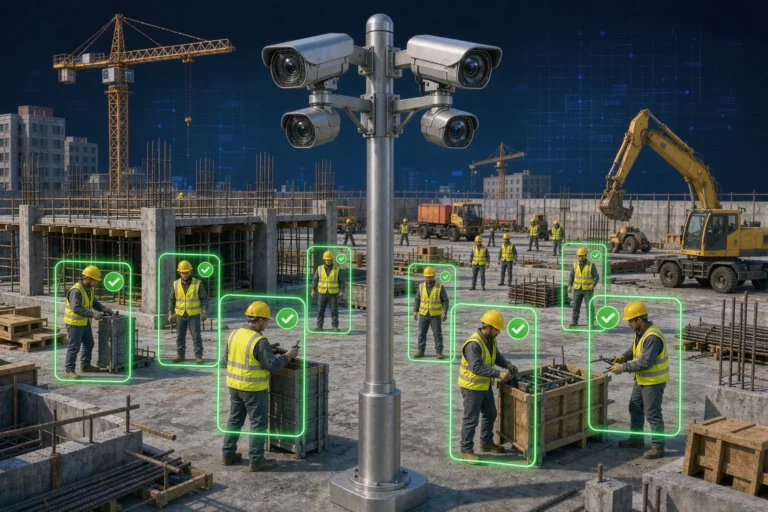
Face Detection: Presence, Counts and Zone Alerts
A face detection model answers a narrower question than most people assume: it tells you that a face is present in the frame, where it is, and how many there are. It does not say who the face belongs to. That single distinction – presence versus identity – is what makes the capability useful in places where identifying individuals would be unnecessary, unwelcome, or legally fraught.
What follows covers where face detection earns its keep, how it sits next to face recognition without becoming it, where the accuracy genuinely holds up, and how to deploy it on cameras you already own.
What Face Detection Actually Does
The model scans each frame and returns bounding boxes around faces. From those boxes a system can do three practical things: confirm that a person is present in a zone, count how many faces are in view, and trigger an alert when a face appears somewhere it should not – a staff-only room after hours, a server aisle, a closed admissions desk.
None of that requires a name. The output is “one person at the counter”, “three faces in the waiting area”, or “face detected in restricted zone at 02:14”. For most operational problems – is the desk staffed, is the queue building, did someone enter the prohibited area – that is the entire answer the business needs.
Detection, Not Recognition
This is the line worth drawing in writing before any deployment. Face detection locates faces; face recognition matches a face to an identity. They are different models with different obligations, and conflating them is the fastest way to lose a privacy review. Where a site does need to confirm who someone is – an access lane, a credential check – that is a separate project with its own justification, and face recognition and verification covers what that involves.
For the everyday case, staying at the detection layer keeps the deployment simple. There is no gallery of enrolled faces, no match score, no biometric record to store or defend. The mirror skill – knowing someone has lingered rather than merely appeared – is handled by person dwell detection, which tracks how long a person stays rather than whether a face is visible.
Where It Pays Off
Five recurring shapes show up across sites:
- Zone presence. Confirm a help desk, reception or guard post is attended. The absence alert is the job of person leaving detection, which fires when a post goes empty.
- Room counts. A live headcount in a waiting room, hall or entrance lobby feeds capacity and staffing decisions without identifying anyone.
- Restricted-area entry. A face in a zone that should be empty after hours becomes an intrusion event. The underlying trigger logic is shared with intrusion detection and a virtual line from line crossing detection.
- Loitering prompts. Repeated face appearances in one spot can flag loitering before it becomes a problem; loitering detection turns that into a rule with a dwell threshold.
- Service evidence. A timestamped count that a desk was staffed, or a restricted door stayed clear, is the record that settles a dispute after the fact.
How Accurate It Is, Honestly
Accuracy is governed by the same conditions as any video model, and a site survey settles most of them before go-live:
- View and distance. A face needs to be large enough in frame. A camera that sees a doorway from across a car park will read presence well and read finer detail poorly – which is fine, because detection does not need finer detail.
- Lighting. A dark entrance or a night-time lot degrades any model. That is a camera and lighting question, not an algorithm one.
- Angle. A face-on or three-quarter view reads reliably; a top-down or fully side view is harder. Positioning the camera at head height on the approach path solves most cases.
- Occlusion. Masks, helmets and hi-vis visors reduce confidence. Design the rule around presence and counts, not around reading expression, and the limitation barely matters.
Because detection asks less of the image than recognition, it is usually the more robust of the two in real deployments. Budget a short commissioning window: review the first week against what you actually see on site, then tune the zone and threshold.
Privacy by Staying Shallow
Detection is the easier conversation with a privacy officer precisely because it stops at “a face is here”. Three choices carry the weight, and they are worth recording before go-live:
Process on site, not in a cloud. When analytics run on an appliance in the building, footage is not shipped to a third party for analysis. The trade-offs are set out in on-premise versus cloud analytics.
Keep the output minimal. What the operation needs is an event and a count, not a face gallery. Configuring the system to emit presence and totals rather than searchable images is what keeps the deployment on the right side of the line.
Agree retention deliberately. Counts can be kept for analytics; raw video should not be kept indefinitely. A written retention window is the question any auditor will ask. For the framework these answers map onto, see the NIST Privacy Framework and the UK Information Commissioner’s Office, and our privacy policy states how we handle footage.
Running It on the Cameras You Already Have
Detection does not need new cameras – it needs a reasonable view of the approach. An edge AI box ingests the streams your existing units already produce, runs the models on-device, and holds the rules as configuration rather than hardware. Systems scale from 2 to 128 channels with 1 to 256 TOPS matched to load, carrying a library of 198+ pre-built algorithms in software. Practically, that means the entrance camera can also be the one that detects presence, and adding a restricted-zone rule later is a settings change rather than a purchase order.
If the broader idea of turning video into events is new to you, what AI video analytics does is the right starting point.
What It Costs
Adding analytics to existing cameras starts at USD 399 for Standard 2, with Standard 4 at USD 999 and Standard 6 at USD 1,599; larger channel counts are quoted per site. Each Starter Kit ships with 10 metres of cabling as standard across the whole kit, with additional cable at USD 25 per 10 metres. The full breakdown is on our pricing page.
For a configuration-led project, the first working configuration on your own footage typically lands in about seven days. Bespoke algorithm development is different: until we have seen your video – the angles, the lighting, the specific zone you need watched – nobody can honestly commit to a date, and we do not.
This is one of the topics we cover in more detail in person detection.
Frequently Asked Questions
Does face detection identify people?
No. It locates faces and reports presence and counts. It never establishes who anyone is, and that is the point: most operational problems need to know that a person is at the desk or in the zone, not whose name is on the face.
How is it different from face recognition?
Detection says a face is present; recognition matches that face to a stored identity. They are separate models with separate obligations. Keep them in separate projects, and the privacy review stays simple because no biometric template is created.
Where does face detection actually help?
Anywhere presence or a headcount is the answer: confirming a post is staffed, counting a waiting room, or alerting when a face appears in a restricted zone after hours. It is the shallow, low-friction layer that avoids enrolling anyone.
Does it still raise privacy questions?
Fewer than recognition, but not none. The safe design is on-site processing, event-and-count output instead of image galleries, and a written retention window. Those three choices are what keep a detection deployment defensible.
Next Step
Send us a photo of the entrance or zone you want watched and we will tell you whether your existing camera can carry the rule. For a wider view of turning cameras into event systems, see our notes for integrators. Start with a Starter Kit to validate presence detection on your busiest door, or tell us your scenario for a configuration quoted per site.