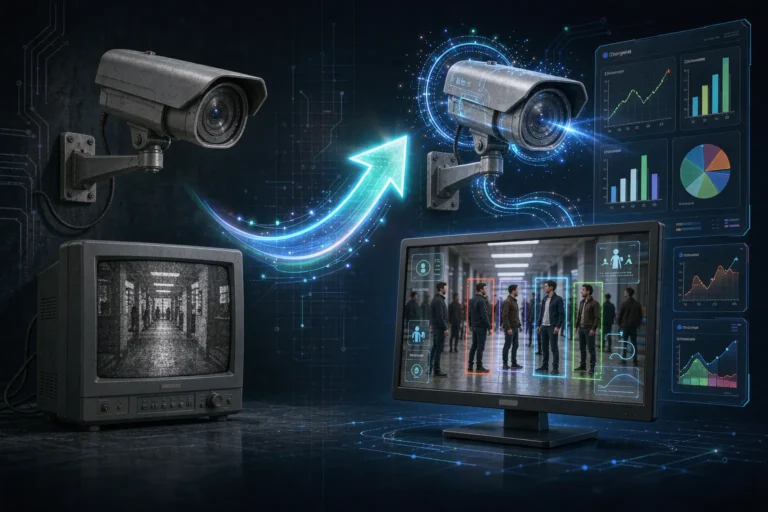
NVR With AI Detection: Reuse Your Recorder, No Cloud Fee
Most businesses already own a network video recorder (NVR) and a set of IP cameras. The recorder stores footage; the cameras capture it. What it usually cannot do is decide what matters. An NVR with AI detection changes that by adding an intelligence layer on top of the hardware you already run, so the same recorder that records a lobby also flags a loiterer, a fallen person, or a vehicle of interest the moment it appears. This guide explains how AI detection works with an existing NVR, why edge processing keeps your video private, and how to scope a rollout that pays once instead of every month.
What an NVR With AI Detection Actually Means
An NVR is the box that receives streams from your IP cameras and writes them to disk. Adding AI detection means a processing unit reads those same RTSP or ONVIF streams and runs models against them in real time. It does not replace the recorder; it sits alongside it. The edge AI video analytics layer watches for the events your site cares about, intrusion, loitering, smoke, a fallen person, an unrecognized plate, and raises an alert on site instead of waiting for a human to scrub footage later. Because the analysis happens at the edge, your recorder keeps doing what it does best while the AI handles the question of what just happened.
Runs on the NVR and Cameras You Already Own
The biggest hidden cost of upgrading to AI is usually the cameras. A good NVR-with-AI setup does not ask you to replace either. It connects to the streams your current cameras already produce and adds detection on top, so a parking structure full of bullet cameras and a floor full of domes join the same AI layer without a hardware refresh. The same reuse principle is shown in our construction site security cameras breakdown, where one on-site box watches cranes, gates, and perimeter from cameras already installed. You start with the zones that matter most and expand channel by channel as budget allows.
One Purchase, Not a Per-Camera Subscription
Cloud-tied surveillance charges per camera, every month, forever. The edge model flips that. You buy a Starter Kit once:
- Standard 2 channels, USD 399
- Standard 4 channels, USD 999
- Standard 6 channels, USD 1,599
Each kit ships the edge AI box and the algorithms you need. Cables are standard at 10-metre length; if a run is longer, each extra 10-metre segment is USD 25. Deployments beyond 6 channels are always quoted per project, we do not publish a number because camera count, retention, and topology vary too much to standardize. The price you see is the price you pay; there is no second invoice next month. The full three-year cost comparison is in our security camera without monthly fee guide.
On-Site Processing and Privacy
Keeping video local is a genuine advantage for any business handling sensitive areas. On-site processing means footage does not stream to a third-party cloud by default, so an internet outage does not blind your cameras and you decide where recordings live and how long they are kept. That posture aligns with modern data-minimization expectations, the EU guidance on GDPR and personal data favors limiting where video travels and who can view it, and we use the NIST Privacy Framework as a reference when configuring access control. Video stays inside your network unless you deliberately push a clip out.
Detection Coverage: What the Algorithms Watch
The breadth of detection is what makes the system feel complete. The platform scales from 2–128 channels and from 1–256 TOPS of compute, which covers a single entrance or a multi-building campus. More than 198+ algorithms are available, person and vehicle detection, loitering, intrusion, smoke, fall, hard-hat, and license plate reading among them, and you switch on the rules each zone actually needs. Plate reading is a common requirement at gates and garages; we cover it in depth in our license plate recognition guide, and the warehouse angle is explored in the warehouse camera system scenario.
Deployment and Support
Configuration-led deployments move quickly: a standard setup reaches a first pilot in about 7 days. If you need a custom detection rule, we review your actual footage before committing to a date, bespoke models depend on the scenes and lighting you record, so we scope them honestly rather than promise a calendar. After delivery, support is straightforward: there are no refunds on the store, standard kits include a 30-day replacement window, and custom work is commissioned until it performs to the agreed scope. Buyers weighing options often compare against our best AI security camera system overview, which frames the same one-purchase, on-site model across deployment sizes.
For a related deployment angle, see our guide to a Nest Camera Alternative: Edge AI, No Monthly Fee.
For a related deployment angle, see our guide to a Verkada Alternative: Edge AI, No Vendor Lock-In.
Frequently Asked Questions
Can an NVR with AI detection work with my existing cameras?
Yes. The system reads the RTSP or ONVIF streams your current IP cameras already produce, so domes, bullets, and the NVR you run today all stay in place. The AI layer adds detection on top of those streams rather than replacing the recorder, which is what keeps the rollout affordable and fast.
Do I need to replace my NVR to get AI detection?
No. The edge AI box connects to your existing recorder streams and runs detection alongside it. Your NVR keeps recording to disk exactly as before; the AI unit handles real-time event analysis and alerting. This means you add intelligence without a forklift upgrade of your storage hardware.
How many cameras can one edge AI box handle with an NVR?
A single box scales from 2–128 channels and 1–256 TOPS of compute, which covers a single entrance up to a multi-building property feeding one recorder. Larger or multi-site rollouts are quoted per project after we review camera count, retention, and topology, so the design matches the load rather than guessing.
What happens to AI detection during an internet outage?
Detection runs on a local box next to your NVR, so core analytics and alerting keep working without an outbound internet connection. Recording and event detection continue during the outage; you only need connectivity when you choose to view remotely or push a notification to a phone, and a UPS on the appliance covers short power dips.
Ready to Add AI to the Recorder You Already Run?
If you want detection across your entrances, lots, and back-of-house areas without a per-camera cloud fee, start with a Starter Kit sized to your property. Tell us your scenario and we will map the channels and algorithms you need. See the Starter Kit options, or email info@aisurveillancecamera.com and we will help you scope it.