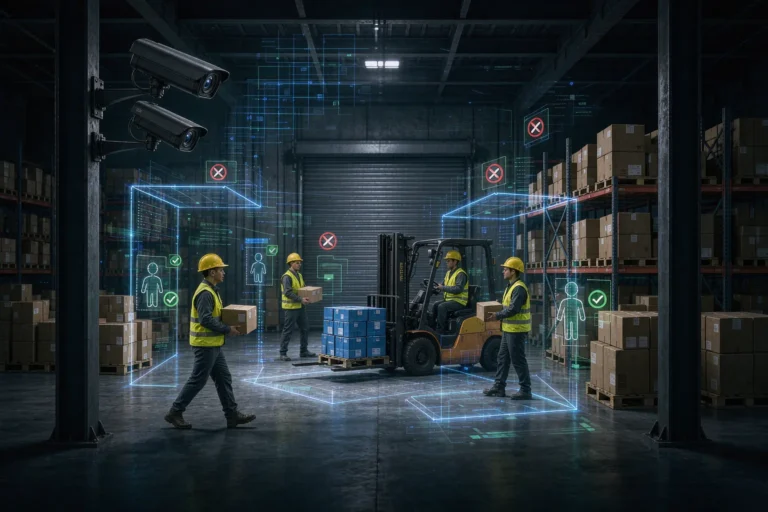
School Campus Safety System: Violence, Access & Perimeter AI
A school security system has a harder job than almost any other surveillance deployment, for a reason that has nothing to do with technology: the window for intervention is measured in seconds, and the people who need to intervene are usually in a classroom rather than in front of a monitor. A fight in a corridor is over in under a minute. An unfamiliar adult inside a perimeter may be anywhere on campus within two. Recorded video handles neither; it only explains what happened afterwards. A school campus safety system built on live detection is the difference between a report and a response.
Campus security programmes sit at the intersection of surveillance practice and child-safeguarding policy; the Security Industry Association (SIA) publishes guidance on operational surveillance, while the governance questions around automated analysis are covered in the broader Artificial intelligence literature.
The Four Problems a Campus Actually Has
Most campus security conversations start with a long list of worries. In practice they collapse into four.
- Violence between students. Fights, ambushes and the crowd that forms around them. These cluster in predictable places — corridors between lessons, stairwells, the far side of sports facilities, toilets and changing rooms.
- Unauthorised adults on site. The highest-consequence scenario, and the one that perimeter cameras alone rarely catch, because the failure is usually a propped door or a tailgated entry rather than a climbed fence.
- Crush and crowd risk. Assembly points, narrow stairwells at dismissal, and event egress. Density and movement, not identity, are the signals that matter here.
- Coverage that quietly fails. A camera knocked, covered or left misaligned after maintenance is a camera that is not protecting anyone — and on a campus nobody notices for months.
How the Algorithms Cover Them
| Priority | Detectors used | What it produces |
|---|---|---|
| Violence prevention | Aggression / fighting, running, crowd gathering | Escalation alert within seconds, with location |
| Perimeter protection | Intrusion, fence climbing, loitering | Out-of-hours alert dispatched to who can act |
| Access awareness | Face detection, watchlist matching (where lawful) | Known-banned individual flagged at the gate |
| Gate & traffic | Plate recognition, two-wheeler parking, departure | Vehicle log for pickup and delivery control |
| System health | Camera tampering, displacement | Maintenance task before coverage is lost |
The table matters less for any single row than for how the rows combine. Aggression detection alone produces an alert that a duty officer has to interpret; aggression detection combined with crowd formation and running produces an alert that already carries a severity judgement. That combination logic is where a campus system stops being a camera network and starts being a safety function.
Deployment: Gates, Corridors, Grounds
Three zones, three different jobs.
Gates and arrival points. This is where vehicle and identity logic lives: plate recognition for the vehicle log, and face detection at the pedestrian entry for watchlist matching where the jurisdiction permits it. Get the camera angle right here — a camera looking straight down at the top of heads will not support recognition.
Corridors and stairwells. These are the violence and crush zones, and they are usually the worst-lit and most crowded. Detection here depends on coverage rather than on identification, and it should be tuned for the transition periods between lessons rather than for quiet periods. Corridor cameras also carry fall detection, because a fall on a stairwell is a genuine and under-reported campus injury.
Grounds and perimeter. Out-of-hours intrusion, fence-line loitering and the approach paths to buildings. This is where camera tampering detection earns its place: a camera on a remote boundary is exactly the one someone will try to blind.
All of it runs on-device. Our edge hardware covers 2–128 channels and 1–256 TOPS, and ships with the full library of 198+ algorithms, so a school can start with violence and perimeter detection and add plate recognition for the gate later without buying new hardware. And because processing is local, video of students does not leave the campus network — the posture that makes these programmes defensible to parents and governors.
Governance: The Part That Decides Whether It Survives
More campus technology fails on governance than on accuracy. Three decisions made early determine whether a system is still trusted a year later.
- Who sees what. Access should be role-based and narrow. A duty officer needs live alerts; a headteacher may need incident review; a classroom teacher needs neither. Least-privilege access is both good practice and the answer to most staff objections.
- What is retained and for how long. Set retention to the shortest period that meets your incident-review needs — typically a rolling window measured in days rather than months — and document it. A written, published retention policy is worth more in a safeguarding conversation than any technical control.
- What the system is for. Write down the permitted uses before activation, and be explicit about the prohibited ones. Detection deployed for safety that later gets used for routine discipline is the fastest way to lose staff and parent consent, and the restriction is much easier to set at the start than to impose later.
Schools that publish a short, plain-language notice to parents explaining what is detected, what is stored, and who can view it generally find the conversation far easier than they expected. Opacity, not surveillance, is what generates complaint.
Who This Suits
Primary and secondary schools, where the dominant concerns are unauthorised adults and duty-of-care incidents. Universities and colleges, where the scale is larger, the perimeter is porous, and the pattern includes late-night movement across campus. Boards with multiple sites, where consistency of configuration across schools matters more than any single feature. And childcare and nursery settings, where access control is the near-total priority.
How the detection itself works is covered in person leaving detection. How the detection itself works is covered in safety harness detection.
For the on-site view, read Fighting & Violence Detection: Public Safety Alerts. See how it runs on a real site in Campus Security: AI Solutions for Schools & Universities.
FAQ
Can it identify an unfamiliar person and alert? It can flag a person at a controlled entry who does not match a known list, where local law and your own policy permit watchlist matching. It cannot and should not attempt to infer intent, and it is not a substitute for a reception and sign-in procedure — it is a second line behind one.
Does it work in a corridor with the lights off? Corridors are rarely fully dark, and infrared-capable cameras work well because detection reads shape and movement rather than colour. The genuine limitation is a completely unlit area, where no video system performs; those are better addressed with low-level permanent lighting than with analytics.
How quickly does a fight get reported? Detection is a matter of seconds once the behaviour is unambiguous, and the alert goes to a chosen device rather than to a monitor nobody is watching. The larger variable is human: whether someone with authority is on the receiving end. Configuration work should include deciding that, not just installing the detectors.
Will we have to replace our cameras, and what does it cost? Most schools keep their existing cameras — the analytics run on an edge box that consumes the same streams. Cost is a one-time hardware purchase sized by channel count, with no per-camera monthly fee, which suits education budgets far better than subscription pricing. A Starter Kit trial on your own corridors is the usual first step.
Tell Us Your Scenario. Send us a site plan and tell us which of the four problems worries you most, and we will specify the camera positions and detectors. Start with a Starter Kit running on your own footage, or contact us to scope a single-campus pilot.