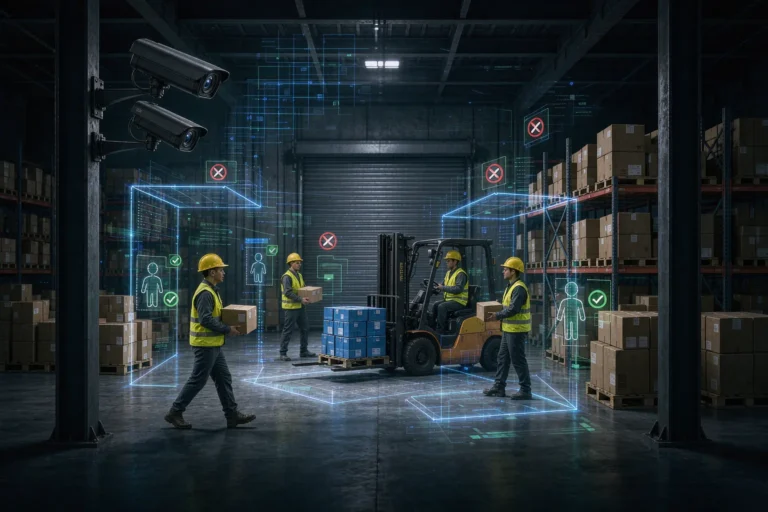
Retail Loss Prevention with AI: Turn Store Cameras into a Real-Time Shield
Retail loss prevention has always been a numbers game, and right now the numbers are moving the wrong way. Shrink — the gap between what a store should sell and what it actually sells — quietly erodes margins that retailers fought hard to earn. The good news: the cameras you already have can do more than record. With AI video analytics on-device, your existing CCTV becomes a real-time shield against shoplifting, organized retail crime and the small frictions that add up to big losses.
The Hidden Cost of Retail Shrink
The National Retail Federation’s annual security survey consistently puts the total cost of shrink in the tens of billions of dollars worldwide, with shoplifting and employee theft accounting for the largest share. Organized retail crime has pushed the problem further up the priority list for chain operators, who increasingly face coordinated groups rather than lone amateurs. For a store operating on single-digit net margins, every percent of shrink is a direct hit to profit. What makes shrink so insidious is that much of it goes unnoticed — a scanner miss here, a return fraud there, a quiet inventory build-up in a stockroom.
Traditional retail loss prevention relies on security guards, cameras reviewed after the fact, and exception reports generated days later. By the time a pattern is spotted, the merchandise is already gone. AI-powered retail loss prevention flips the sequence: it detects suspicious behavior while it is happening and hands your team an alert, a snapshot and a clip in the same minute.
How Retail Loss Prevention AI Works
Edge AI watches every camera feed in the store simultaneously, running detection models that understand behavior, not just motion. Here is what a typical deployment monitors:
The deployment footprint is deliberately small. One edge box sits in the network closet, the store’s existing cameras connect to it, and rules are configured per zone — high-value aisles get theft detection, the front of store gets loitering detection, the checkout area gets queue analytics. There is no new hardware on the sales floor, no wiring through the ceiling, and no change to the cameras your staff already know. Most single-store retail loss prevention deployments are configured within a day.
Shoplifting & Theft Detection
Behavioral models recognize the sequences that precede theft: reaching into a high-value fixture repeatedly, concealing items, lingering near exits, or loitering in blind spots. Instead of waiting for an incident report, the system flags the behavior to staff in real time, so a response can happen while the person is still in the store. Many operators pair this with audio-free alerts that go straight to a mobile app, so a manager can respond without tipping off the suspect.
The same detection also covers the staff side. Employee theft and fraud — sweethearting, under-ringing, fake returns — show up as patterns that a watchful camera system can flag consistently, giving loss prevention teams a fair and documented basis for investigation.
Loitering & Suspicious Behavior Detection
Loiterers are often scouting. The system tracks dwell time and movement patterns, alerting when someone remains in a zone far longer than typical shoppers. This layer of retail loss prevention also deters organized retail crime groups, who often case a store before a coordinated event.
Queue & Dwell-Time Analytics
Loss prevention and customer experience share the same cameras. Queue-length and dwell-time analytics show where checkout bottlenecks form, letting you open lanes before frustration turns into abandoned carts. The same data stream that protects your margins also protects your conversion rate.
Turn Your Existing CCTV into an AI System
On-device AI changes the economics of retail loss prevention. There is no cloud processing fee per camera, no video leaving the store, and no dependence on internet reliability. The platform runs 198+ industry algorithms on a single edge AI box with 1–256 TOPS compute, supporting 2–128 channels — enough for most single stores and small chains. Analysis happens at the edge in under a second, which matters when the alert needs to reach the floor before the exit.
Privacy also becomes simpler. Because footage is analyzed on-site and never uploaded for processing, you keep full control of what is stored, what is retained and who can access it. For multi-site operators, one dashboard aggregates alerts from every location while each store keeps its own data.
Start Small with a Tailored Sample
You do not need to convert your whole estate to prove the concept. The Starter Kit lets you test detection on a handful of cameras in one store — measure the alerts, review the clips, and see the daily loss report before scaling. Most retailers see value in the first week and roll out location by location.
Ready to Cut Shrink?
Your store cameras already capture every moment that matters; they just need a system that understands what it sees. Tell us your scenario and we will design a free retail loss prevention solution around your store layout, your fixtures and your risk areas. Explore how the same platform protects construction sites and other industries too.
For the full site picture, see ai solutions for retail. The longer explanation sits in ai cameras for retail.
Independent research on shrink and organised retail crime is published by the Loss Prevention Research Council.
Frequently Asked Questions
Can it use the cameras we already have in store?
In most stores, yes. Any camera that outputs an ONVIF or RTSP stream in H.264 or H.265 can be connected. Cameras that cannot see the shelf, till or stockroom door clearly enough are identified during the free store survey and either repositioned or added.
Which loss events can it flag?
You enable the detections that match your shrink pattern: after-hours intrusion, loitering in known high-loss zones, crowding around a counter or till, and dwell time at specific fixtures. The 198+ algorithm library covers far more, but each store usually runs a short list.
Will staff be alerted while it is happening?
Yes, if you want live alerts. Events can push to a dashboard, a mobile device or your existing incident tool by webhook, with the clip attached so a manager can confirm in seconds. Many stores start in review-only mode and switch on live alerts once accuracy is proven on their own footage.
Does this replace EAS tags or POS exception reporting?
No, it complements them. Tags and till data tell you that something happened; video analytics shows what happened and who was there. Most retailers keep both and use the clip to decide whether an incident is worth pursuing.
What does it cost for one store?
Starter Kit systems start at USD 399 for two channels, with four channels at USD 999 and six channels at USD 1,599. Whole-estate rollouts are quoted as a custom build, and what you paid for your Starter Kit tier is credited once against a subsequent custom project.