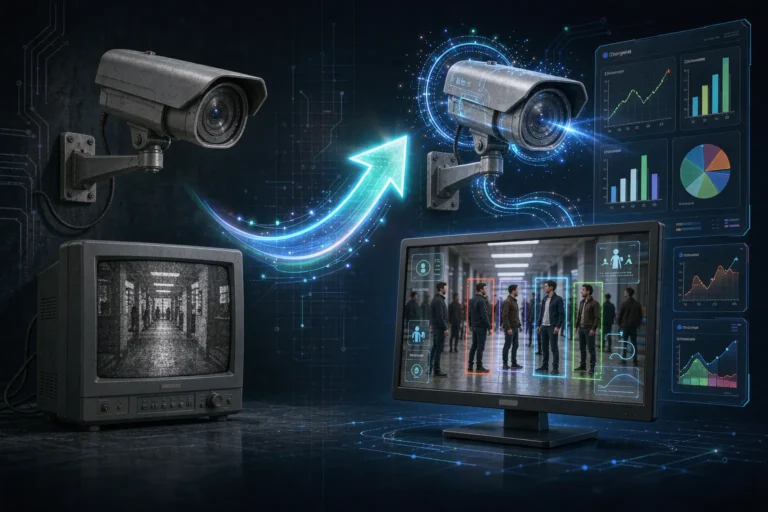
AI Camera vs CCTV: What Actually Changes
An AI camera and a CCTV camera can look identical on a pole. The difference is what happens to the pixels: a conventional CCTV camera writes them to disk for someone to review later, while an AI camera reads them as they arrive and raises an alarm while the event is still happening. That single change – from recording to recognising – is what separates a system that helps you investigate Monday’s incident from one that stops it on Sunday night.
The catch is that buying AI cameras usually means replacing every unit you own. For most sites that is the expensive way to get the outcome. An edge AI box ingests the ONVIF or RTSP streams your existing cameras already produce and applies the same analytics centrally, so the retrofit question and the technology question are separate decisions.
The Difference in One Table
Six dimensions cover almost every comparison buyers actually make:
| Traditional CCTV | AI Camera / AI Analytics | |
|---|---|---|
| Output | Video for later review | Events and alarms in real time |
| Typical use | Forensics after an incident | Intervention during an incident |
| Human workload | Someone must watch or scrub | Cameras watch; staff respond |
| Retrofit | Already installed | Replace units, or add a box |
| Cost shape | Hardware + storage | Hardware + compute + algorithms |
| Failure mode | Nobody saw it | Nobody tuned it |
What Traditional CCTV Still Does Well
Recording is not obsolete. For liability claims, insurance disputes and police requests, archived footage is the artefact that settles arguments, and no analytics layer replaces it. A well-placed conventional camera with good lighting and a sensible retention window remains the backbone of any site’s evidence story – see how site operators think about this in how to upgrade CCTV to AI.
The limitation is attention, not image quality. A guard watching nine feeds stops noticing the tenth after about twenty minutes, and nobody reviews seventy hours of weekend footage unless something has already gone wrong. CCTV is excellent at answering “what happened” and poor at saying “something is happening now”.
What AI Adds to the Same Picture
Analytics turns each stream into a rule engine. Instead of storing everything equally, the system classifies what it sees and only escalates what breaks a rule: a person inside a perimeter after hours, a vehicle moving against a one-way lane, a group forming where groups should not form. The intrusion detection rules most sites start with are a good illustration – the camera does not look different, but the yard now reports itself.
Two things follow from that. Response time collapses from hours to seconds, because the alert arrives while the event is still actionable. And the value of the archive changes: instead of scrolling, you jump to the clip the system flagged. Sites that add loitering detection to the same cameras typically find the deterrence effect matters as much as the response – people who know the yard is watching behave differently.
The Third Option: Keep the Cameras, Add the Intelligence
There is a route that gets the analytics without the replacement programme. An edge AI box sits in the comms cabinet, pulls the existing ONVIF or RTSP streams, and runs the models on-device – 1 to 256 TOPS matched to a system of 2 to 128 channels, with a library of 198+ pre-built algorithms loaded in software. Video never leaves the site, and the cameras you already own keep working exactly as they do today.
The practical consequences matter more than the architecture. No ladder work, no cabling run, no afternoon where half the site is blind during a swap. Algorithms become a software decision rather than a purchase order – the yard that starts with intrusion can add PPE or plate rules later without touching hardware. And mixed fleets stop being a problem, because the box is indifferent to the badge on the camera.
What It Costs and How Long It Takes
Adding analytics to existing cameras starts at USD 399 for Standard 2, with Standard 4 at USD 999 and Standard 6 at USD 1,599; larger channel counts are quoted per site. Each Starter Kit ships with 10 metres of cabling as standard across the whole kit, with additional cable at USD 25 per 10 metres. Compare that against replacing every camera on a twenty-camera site, and the retrofit arithmetic usually settles the question before the technology does – the full breakdown is in our pricing.
For a configuration-led project, the first working demo on your own footage typically lands in about seven days. Bespoke algorithm development is different: until we have seen your video – angles, lighting, the specific thing you need recognised – nobody can honestly commit to a date, and we do not.
Frequently Asked Questions
Do I have to replace my existing cameras to get AI?
No. If your cameras deliver a standards-based stream – ONVIF or RTSP, H.264 or H.265 – an edge AI box can analyse them as they are. Replacement only makes sense where the optics, angle or resolution are themselves the problem.
Will AI work with an older camera installed five years ago?
Usually, yes. Age matters far less than stream compatibility and viewing angle. During evaluation each camera is checked against the rules you want to run, and weak links are flagged before you commit to anything.
Is the video still stored like normal CCTV?
Yes. Analytics sit alongside recording rather than replacing it. You keep the archive for forensics and gain an event layer on top, so flagged clips are indexed instead of buried.
What happens if we need a detection type that is not in the library?
The 198+ pre-built algorithms cover the common site rules. Where a site genuinely needs something unusual, it becomes a custom model scoped against your footage – which is why the first step is sharing video rather than agreeing a deadline.
Next Step
Send us your camera list and the rules you want running, and we will tell you which of your existing units qualify and what the box configuration would look like. For reference on the compression standards these streams use, see the ITU-T H.265 recommendation; for the broader standards landscape behind networked video devices, see IEEE Standards. Start with a Starter Kit to validate on your own footage, or tell us your scenario for a configuration quoted per site.