Camera Tampering Detection: Keep Your Coverage Online
A security camera you cannot see through is worse than no camera at all — it gives you a false sense of coverage while the real view is a hand, a spray can, or a turned lens. Camera tampering detection closes that gap by having the system watch its own eyes: it flags a blocked, covered, redirected, defocused, or disconnected camera the moment it happens, so the blind spot is measured in seconds rather than in the days until someone notices. This guide explains the failure modes, how automated health checks work, and why this belongs in every deployment.
Video reliability is the baseline for any analytics program; the Security Industry Association (SIA) covers the operational side, and the Video analytics — Wikipedia overview explains how every detector downstream depends on a clean feed.
The Blind Spot You Do Not See Coming
Tampering is rarely dramatic. It is a plastic bag over the dome, a sticker on the lens, a knocked-loose mount, a smeared fingerprint, or a cable pulled during a shift change. None of it triggers an alarm — the camera just quietly stops seeing. For a site that trusts its footage for safety, access, or investigations, a disabled camera is a liability that grows silent until the day you need the clip and it is not there.
How AI Self-Checks the Camera
The detector watches each feed for the four failure states continuously:
- Occlusion — the lens is blocked by a bag, spray, tape, or paint; the scene goes dark or flat.
- Deflection — the camera is physically turned, so its view drifts off the zone you set.
- Defocus — the image goes soft or smeared, undermining every other detector on that feed.
- Signal loss — the stream drops, whether from a cut cable, power loss, or network failure.
Configuration is per camera, not global. You draw the region the lens should see and set how sudden a change must be before it alerts, so a camera aimed at a busy doorway is not flagged by normal scene motion while a camera over a quiet exit still catches the smallest cover-up. That tuning is what keeps the feature useful instead of noisy. All of this runs on-device at the edge, so the health check keeps working even when the network is down, and the analysis never leaves your site. Our edge boxes cover 2–128 channels and 1–256 TOPS of compute, and the same hardware carries the 198+ algorithms in the library — meaning a tamper event on one camera protects every other detector on that feed, from flame detection to intrusion alerts.
A 24-Hour Health Patrol
Most sites still check cameras on a monthly walk or only when a clip goes missing. Tamper detection replaces that with a continuous patrol: every camera reports “healthy” or raises a typed alert the instant something changes, and a dashboard shows fleet health at a glance. Because the alert carries the failure type, a technician fixes the right camera on the first visit instead of guessing. It also pairs naturally with the full algorithm library, where displacement detection catches the slower drift that occlusion detection does not.
Who Needs It
Everyone with cameras. The use cases are broad because the risk is universal: any feed a site trusts for safety, access, or evidence is a feed someone may try to blind. The question is not whether tampering can happen but how fast you notice — and continuous self-checks turn that from days into seconds.
- Perimeters & gates — a covered camera is a masked entry point; tamper alerts make that visible.
- Retail & ATMs — a bagged lens is a classic pre-theft move; seconds matter.
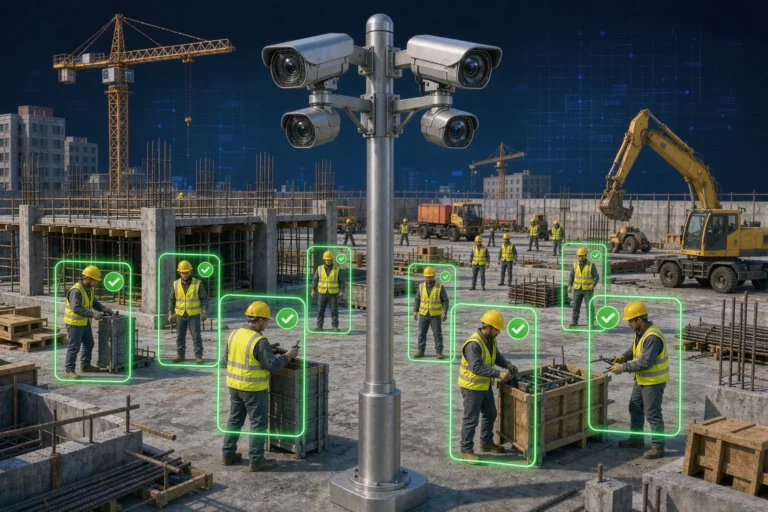
- Construction & remote sites — knocks and weather shift mounts; catch drift before it blinds safety analytics.
- Transport & public spaces — high-traffic, low-supervision areas where a disabled camera is easily missed.
This is applied end to end in school security system.
See it applied end to end in our guide to church security cameras.
FAQ
Will rain, glare, or reflections cause false alarms? Brief weather changes are part of normal scene variation and are ignored; a tamper alert fires on a sustained, typed change — blocked, moved, blurred, or no-signal — not on a passing reflection.
Can it trigger an automatic re-check or alert? Yes. The event is an output your workflow can route to a dashboard, a ticket, or on-site paging, and many sites auto-open a re-inspection task so nothing sits unresolved.
Does it work if the whole camera goes offline? Signal-loss detection is one of the four states, so a fully dropped feed is itself a tamper-class alert — the system reports the camera missing rather than assuming it is fine.
How is this different from camera displacement detection? Tampering catches the active block, cover, defocus, or loss; displacement detection catches the slower angle drift after a bump or wind. They are complementary — together they cover both the sudden attack and the quiet creep.
Tell Us Your Scenario. Want camera-health checks running on your own feeds? Our tested configurations are available on a Starter Kit — explore the Starter Kit or contact us with your camera map.