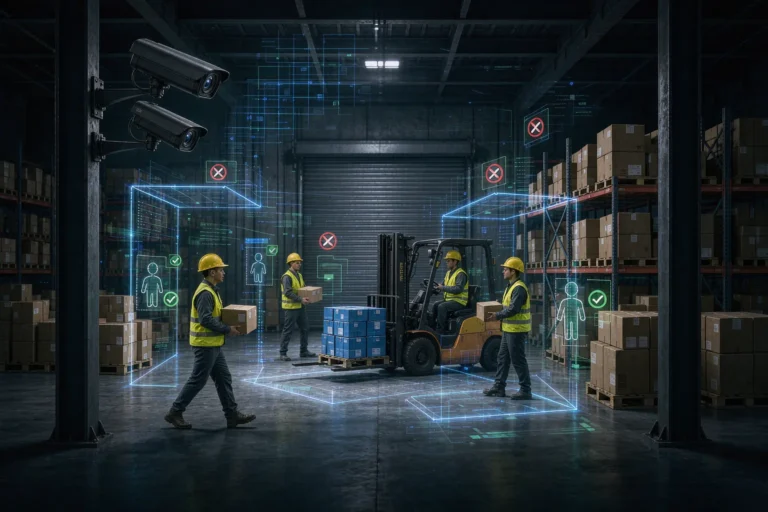
Mining Site Security Cameras: Edge AI, No Cloud
A working mine already carries dozens of cameras — pit perimeters, haul roads, processing plants, workshops, fuel and explosive storage, and camp access points. Most of that footage lands on a recorder and is only reviewed after something goes wrong. Adding intelligence to the network you already own is the fastest way to turn passive recording into active protection. Our edge AI video analytics guide explains how detection runs on your own hardware instead of a cloud subscription.
Why Mining Sites Need On-Site Intelligence
A mine is not a typical office park. The site is large, the environment is harsh, and the people, vehicles and materials in motion are heavy and dangerous. Safety teams cannot watch every stream in real time, yet the cost of a missed event — a person in a blast exclusion zone, an unattended excavator, a fuel bowser parked outside its bay — is measured in injury and downtime, not just loss. Edge AI reads the RTSP feeds your existing cameras already produce and raises an alert the moment a rule is broken, so the response is measured in seconds rather than in a post-incident review. Regulators and insurers increasingly expect clear, documented controls around hazardous areas and high-value assets, and a searchable, on-site event log is far easier to defend than a stack of unread recordings. For operations comparing build options, our no-monthly-fee overview shows how a one-time build compares with a recurring cloud bill.
Reuse the Cameras Already on Site
You do not need to rip out fixed domes, bullets and thermal units to get smarter coverage. A local edge appliance plugs into the streams your cameras already broadcast, which means zero new lenses, no re-cabling of the network, and no lock-in to a single vendor’s recorder. That matters on a mine where cameras are already positioned for coverage and a forklift of new hardware is its own project. The same on-site approach is shown in our construction site cameras scenario, where an on-site build keeps every frame on the property instead of streaming it to a cloud. Most mine cameras speak RTSP or ONVIF, and that is exactly what the appliance consumes — no replacement, no retrofit, no vendor lock-in.
Offline by Design: Coverage When the Network Doesn’t Reach
Remote pits and processing plants often sit beyond reliable connectivity, and a cloud-only system goes blind the moment the link drops. An offline build keeps detection and storage on a local appliance, so the system keeps working during an outage and no video is copied off the site. That local-first design is critical where the internet is weak or absent for stretches of the day. See how our offline CCTV AI detection guide keeps coverage alive without a constant connection, and why our cloud-risk explainer matters most for remote operations where a dropped link should never mean a blind site.
What Edge AI Detects on a Mine Site
The detection library covers 198+ algorithms, so one appliance can carry perimeter, safety and operational rules at the same time. Typical mine use cases include perimeter intrusion after lock-down hours, unauthorized entry into blast or exclusion zones, a person missing a hard hat or vest, a vehicle entering a pedestrian area, haul-road speeding, smoke or fire near plant and storage, fuel and explosive storage tampering, and license-plate reads at the gate and the camp. A license plate recognition guide shows how gate reads work entirely on site. Because the same appliance carries safety, security and operational rules together, a single deployment can watch for both a missing-vest worker and an unauthorized truck at the same gate, without adding separate systems. The build spans 2–128 channels and 1 to 256 TOPS of compute, so a single camp gatehouse and a multi-pit operation both fit without a rebuild.
Pricing Without a Per-Camera Tax
Instead of a monthly fee billed per camera forever, a one-time Starter Kit is sized to how many cameras you actually run:
- Standard 2 channels, USD 399
- Standard 4 channels, USD 999
- Standard 6 channels, USD 1,599
Each kit ships the edge appliance and the detection algorithms your zones need. Cables are standard at 10-metre length, and if a run is longer, each extra 10-metre segment is USD 25. Deployments beyond 6 channels are always quoted per project, because camera count, retention windows and site topology vary too much to standardise — we scope after reviewing your footage rather than quoting a number up front. Against a competitor plan that bills roughly USD 39–108 per camera per month, a six-camera site can pay for the on-site build inside a single year while keeping video under your control. The Starter Kit page maps channel count to cost, and our subscription-free system explainer covers the same model across site sizes.
Want the cameras you already own to stay on site too? Our Cloud vs Local Camera Storage Cost: What You Pay guide shows how on-site edge AI keeps footage on your own hardware.
Want the cameras you already own to stay on site too? Our WiFi vs Wired Security Cameras for Business guide shows how on-site edge AI keeps footage on your own hardware.
Want the cameras you already own to stay on site too? Our AI CCTV System for Business: Edge AI, No Cloud guide shows how on-site edge AI keeps footage on your own hardware.
Frequently Asked Questions
Can edge AI run on our existing mine cameras?
In most cases yes. An on-site appliance reads the RTSP or ONVIF streams your existing IP cameras already produce, so domes, bullets, thermal and pan-tilt units stay exactly where they are. You add a local box for intelligence instead of swapping hardware, which keeps the rollout fast and low risk. Because nothing is rebuilt, the project can start with the highest-risk zones — blast exclusion, fuel storage, the main gate — and expand later as the rules prove their value.
Does any video leave the site?
No. Detection and storage both run on your own hardware, so footage does not stream to a third-party cloud and keeps working if the internet connection drops. That on-site custody is the part safety and compliance teams care about most, and it is far easier to justify than a service that copies video offsite. For operations with workforce-monitoring obligations, pairing the build with a GDPR-aware on-site policy keeps retention and access under your control rather than a vendor default. The NIST Privacy Framework is a helpful reference for mapping how video data should be handled and who should reach it.
How much does a mine-site build cost?
A one-time Starter Kit — Standard 2 channels at USD 399, 4 at USD 999, 6 at USD 1,599 — replaces a recurring per-camera bill with a single purchase, and each extra 10-metre cable segment is USD 25. Configurations beyond 6 channels are quoted per project rather than sold as a fixed kit, because retention and topology vary by site. Against a subscription that bills every camera every month, the on-site build usually pays for itself well inside three years, and the video stays on your own network the entire time. The NFPA fire and life safety guidance is a useful reference when planning detection around plant and storage hazards.
What happens if we have more than 6 cameras or unusual layouts?
Beyond 6 channels we quote per project because camera count, retention and topology vary too much to standardise. A standard build reaches a first pilot in about seven days once we see your camera list; a custom layout with hazardous-area or long-haul coverage is scoped after we review the footage, and we do not commit a date until the layout is clear. Support follows the same rule as the product: the site runs a No refunds policy, a standard kit carries a 30-day exchange window, and a custom build is commissioned until it performs to the agreed scope.
Ready to Make Your Site Smarter?
If you want mining site security cameras that reuse the lenses you own, keep footage on site, and charge once instead of every month, start with a Starter Kit sized to your operation. Tell us your scenario and we will map the channels and algorithms you need. See the Starter Kit options, or email info@aisurveillancecamera.com and we will help you scope it.